The Navidson Record
House of LeavesThe Navidson Record is the documentary made by Will Navidson about his family’s house on Ash Tree Lane and the expanding darkness within it. Its decisive significance lies in the conflict between literal evidence and impossible space: the film insists that the events happened, yet its measurements, images, recordings, and missing images repeatedly defeat ordinary explanations. What begins as a record of a house becomes a record of the limits of recording itself.
Origin and Public Circulation
The film did not initially exist in its completed form. Nearly seven years before the account’s present moment, a five-and-a-half-minute optical illusion circulated under the title “The Five and a Half Minute Hallway.” The image seemed technically modest, barely beyond the abilities of an NYU film-school graduate, but it was accompanied by the claim that everything shown was true. No official distributor released it. Instead, VHS copies passed from hand to hand, each successive dub degrading the image while preserving the central revelation: a doorway that should have opened onto ordinary insulation or siding opened onto a narrow black hallway.
A second short appeared less than a year later. “Exploration #4” lasted eight minutes and was more discontinuous, hurried, and violently edited than the first film, leading viewers to suspect that it represented fragments of a much larger expedition. Its opening catches Will Navidson already speaking, exhausted, depressed, and pale, and presents him contemplating the destruction of the house while admitting that he cannot think clearly enough to burn it down. These fragments transformed curiosity into pursuit: people searched for Navidson and the house, but the quests failed.
Almost three years after the first hallway footage began circulating, Miramax quietly released The Navidson Record in a limited run. After opening in New York City and Los Angeles in 1993, it screened throughout the United States. It was not a blockbuster, yet it continued to generate revenue and attention through reviews, letters, books, university seminars, doctoral dissertations, magazine references, and late-night television. Japan, France, and Norway honored it with awards, although the spectral Navidson never appeared to accept them. The film’s cultural afterlife thus intensified its mystery: its creator remained absent while the record acquired an increasingly substantial public existence.
The Film Within the Film
The Navidson Record contains two films: the one Navidson made and the one he originally set out to make. The completed documentary is remembered as an encounter with the house’s nightmare, but the intended project supplies an earlier context. The opening footage, shot in April 1990, offers no warning that the family will face anything extraordinary on Ash Tree Lane. Navidson appears wholly innocent of the impending danger, and the house’s nature remains beyond both his imagination and his suspicions.
This separation between intention and result gives the documentary a structural irony. The filmmaker seems to begin with a controlled project, but the finished work becomes an archive of forces he cannot master. Its meaning is not simply imposed by later commentators who treat the house as a symbol of the unknowable, architecture, psychology, or contemporary culture. Will Navidson insists that the documentary should be taken literally. His warning is equally literal: anyone passing the house should neither stop nor slow down, because there is nothing there and the place should be feared. The film’s ending makes that warning credible enough that many viewers choose to heed it.
Evidence, Measurement, and Impossible Space
The documentary’s central disturbance is not only what the house contains but what it does to measurement. After exhausting more obvious explanations, Navidson returns to the building plans and compares them with measurements taken using a 25-foot Stanley Power Lock. He then measures the exterior from the second-story level with a 100-foot Empire fiberglass tape. The distance from the far end of the master bedroom to the far end of the children’s bedroom is 32 feet 9 and three-quarter inches, a result corroborated by the plans within an inch.
The internal measurement is different. When Navidson adds the length of the new area, the two bedrooms, and the widths of the walls, the result is 32 feet 10 inches exactly. The width inside the house therefore exceeds the width outside by one-quarter inch. Suspecting an error, he drills through the outer walls and, with Karen Green’s help, threads fishing line through the holes, across the master bedroom, the new space, and the children’s bedroom, keeping it straight, level, and taut. The measurement remains 32 feet 10 inches. The discrepancy is not an optical illusion or a careless calculation but a physical impossibility preserved as evidence.
The same conflict between spatial expectation and spatial fact recurs throughout the film. In the deeper passages, Navidson encounters an entrance larger than the others, arcing above him into an undisturbed blackness where his flashlight finds neither walls nor ceiling. The house’s apparent scale expands only when the record reaches a place that ordinary architecture cannot contain. A doorway becomes a threshold into a world in which enclosure, distance, orientation, and depth no longer behave consistently.
Recording Technologies and Points of View
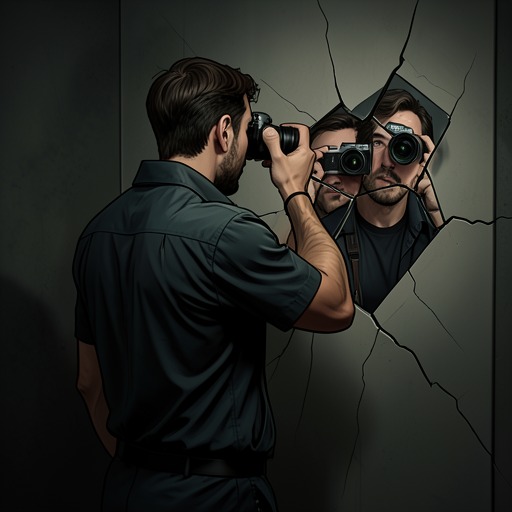
The documentary’s credibility depends heavily on the differences among its recording devices and operators. Navidson’s own camera is remarkably steady. Even under terrifying conditions, his footage rarely contains a shake, tremble, jerk, or poorly composed frame. His experience as a photojournalist gives him the technical advantage to face and shape the subject rather than merely react to it.
The contrast with other footage is stark. Holloway Roberts’s tape is tilted, unfocused, badly lit, and shaken, finally collapsing into oblivion when danger becomes overwhelming. Karen Green’s and Tom Navidson’s tapes are technically inexperienced and useful chiefly for their content. The film therefore separates seeing from merely possessing images: Navidson’s steadiness does not make the house safer, but it makes its otherness visible.
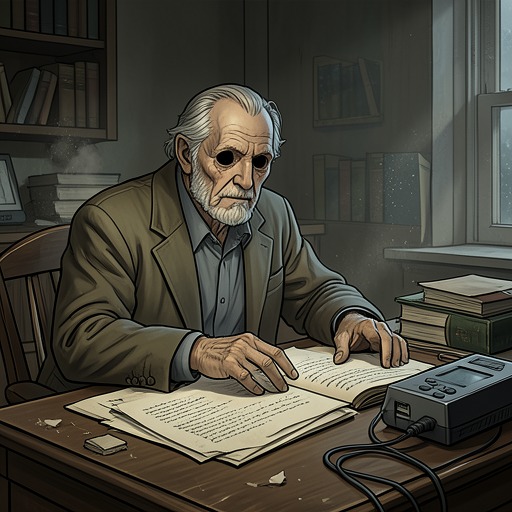
The living room becomes a temporary laboratory of this evidentiary system. Billy Reston moves through a field of equipment that includes three monitors, two three-quarter-inch decks, a VHS machine, a Quadra Mae, two Zip drives, an Epson color printer, an old PC, at least six radio transmitters and receivers, electrical cord, video cable, a 16mm Arriflex, a 16mm Bolex, a Minolta Super 8, flashlights, flares, rope, fishing line, batteries, tools, compasses, and a broken megaphone. Shelves hold sample jars, graphs, books, and an old microscope. The abundance of instruments suggests that enough technology might convert the impossible into knowledge; the later footage demonstrates that no accumulation of devices guarantees comprehension.
The Fall into Darkness
During an ascent in the house, Navidson steadily draws slack rope from the floor while lifting Billy Reston through the stair shaft. Halfway up, the excess rope begins to vanish at Navidson’s feet, and the portion in his hands slips rapidly enough to burn a gash into his palms. He releases it, but Reston does not fall. Instead, his ascent accelerates under the pull of an unseen force. Later, Reston reports that the pulley at the top tore loose from the banister and that Tom Navidson caught both him and the rope before they plunged down the shaft.
Navidson’s own descent produces a still more extreme spatial contradiction. After waiting for almost an hour, he hears something clatter behind him and finds the third quarter. If Tom dropped it shortly after Reston reached the top, the coin has been falling for at least fifty minutes. The implied distance is impossible: the calculation exceeds the earth’s circumference at the equator. The falling quarter converts elapsed time into an unmeasurable depth and turns a small object into proof that the house’s interior has escaped terrestrial scale.
Later, at the brink of an abyss, Navidson finds a structure resembling a bartizan, no more than seven feet high, containing a winding staircase lying on its side and penetrating the wall facing the void. After he sleeps, the single exit disappears and the stairs rotate above him through the ceiling. During another passage he climbs onto a narrow terrace through a window, only to find the window and the room vanish when he turns back. He remains on an ash-black slab apparently supported by nothing, with darkness below, above, and beyond.
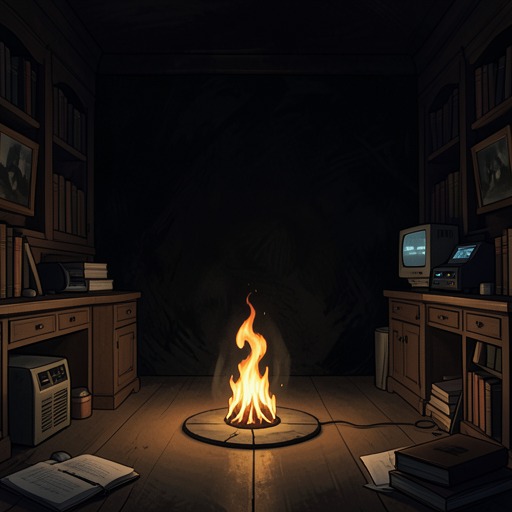
The film’s climax abandons the expectation that images will explain what has happened. Navidson’s flashlights fail, his watch stops, and his supplies diminish. One flare falls straight down without reaching a bottom; another floats and becomes, for a while, a lamp by which he reads; the third shoots upward and disappears. He records that he has no food or water, that he is cold, and that his feet hurt. Soon after, the slab disappears, leaving him unsure whether he is floating or falling. Nearly six minutes of the documentary are black, accompanied only intermittently by fragments of his voice, still photographs, and the sounds of flares and deteriorating equipment.
Reception, Survival, and Significance
The six minutes of darkness provoked sharply divided responses. Some viewers found the audience’s discomfort almost comic as it squinted at the blank screen and glanced toward the red exit signs. Michael Medved treated the absence of images as the end of cinema, while other critics called the film a fiasco or a stunt; Janet Maslin responded with admiration for its audacity. Television comedians reduced the ending to jokes about a forgotten lens cap, cheap production, and darkness, yet those parodies also confirmed how powerfully the blank screen had entered public memory.
Serious attention shifted from the absent image to the surviving sound. Tom Holman helped clean the tapes and monitor the transfers, and commentators noted the extraordinary brightness and intimacy of Navidson’s voice. Even when his words become difficult to understand, they seem close rather than safely buried in the blackness. Silence dominates whenever he does not speak, and not even the house’s growl disturbs that isolation. The documentary therefore makes sound carry the burden that vision can no longer bear.
The record does not end with a simple death. Navidson survives, and the film and tapes made during his journey survive with him. His survival has a severe physical cost: frostbite takes his right hand and part of one ear; patches of facial skin and his left eye are lost; his hip shatters and requires replacement; doctors say he will need a crutch for life, and he does. The damaged body and damaged archive mirror one another. Neither returns intact from the house, but both remain as testimony.
The Navidson Record is consequently more than a documentary about an impossible building. It is an object in which story and discourse continually pull apart: events appear through films, VHS degradations, photographs, interviews, audio fragments, measurements, and long stretches of blackness, while the chronological reality they might establish remains fractured. Its instruments promise verification, its images insist on presence, and its omissions preserve the void. The record’s lasting terror comes from that contradiction: it offers evidence that something happened while refusing to make the happening fully knowable.